
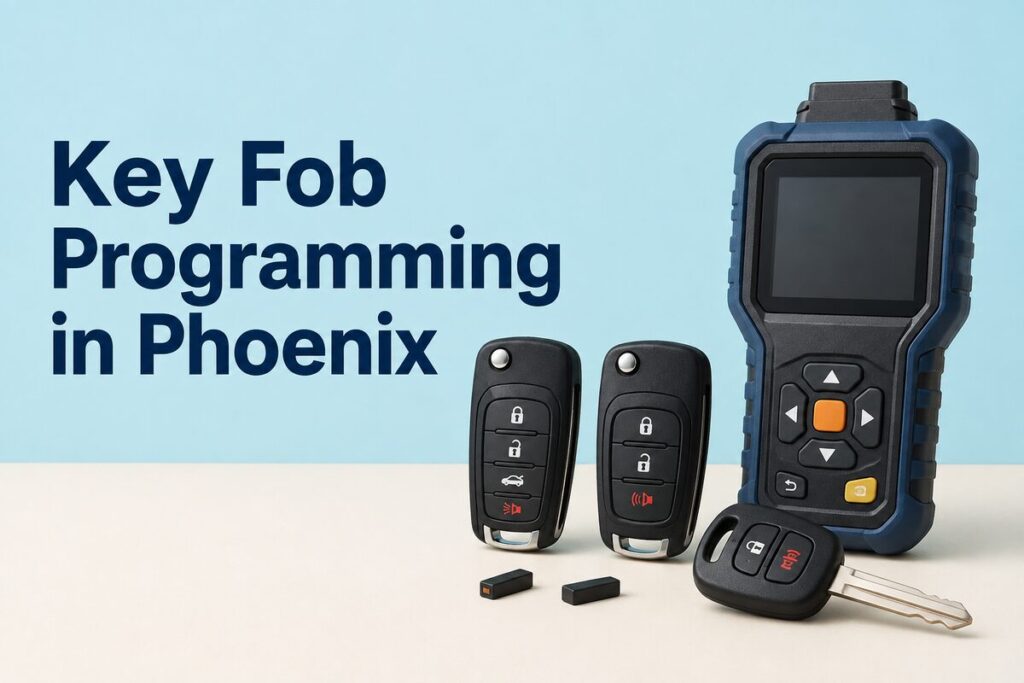
Key fob programming in Phoenix may be needed when a replacement remote has never been paired, a vehicle no longer recognizes an authorized fob, or an all-keys-lost procedure changes the keys stored in the system. However, programming is not the solution for every unresponsive remote.
A depleted battery, damaged button, cracked housing, incorrect fob, worn emergency blade, or vehicle-side electrical problem can produce similar symptoms. Accurate diagnosis should come before pairing or replacement.
First, Identify What Has Stopped Working
A modern key can contain several functions. Remote buttons may operate the locks, a transponder may authorize starting, and a proximity circuit may support keyless access. An emergency blade can provide mechanical entry.
Because these functions can fail separately, describe the symptom precisely:
- Do the lock and unlock buttons respond?
- Does the vehicle start normally?
- Does the vehicle detect the fob inside the cabin?
- Does the emergency blade open the authorized door?
- Does a second fob work correctly?
- Did the problem begin after a battery or housing replacement?
The answers help distinguish programming from battery, hardware, blade, or vehicle issues. The company’s key fob programming service covers compatible remote and proximity-key situations.
Common Reasons a Car Remote Stops Working
Several problems can make a key fob appear to need programming.
The Fob Battery Is Depleted or Installed Incorrectly
A weak battery can reduce operating range or stop the buttons from responding. A replacement battery must match the correct type and orientation. Bent contacts, dirt, or a battery that does not sit securely can prevent reliable power even when the battery is new.
Replacing a battery does not automatically require programming. Some vehicles retain recognition, while others may use a manufacturer-specific synchronization step.
The Buttons or Housing Are Damaged
Repeated use can wear buttons or contact pads. A cracked housing may shift the circuit board, expose it to debris, or prevent contact with the correct switch. The transponder may also be separate from the board.
The Replacement Fob Is Incompatible
Matching the exterior shape is not enough. Similar fobs may use different frequencies, identifiers, immobilizer systems, or functions. Programming cannot correct an incompatible device.
The Vehicle Lost Synchronization With the Remote
In some systems, the remote portion may lose synchronization while the immobilizer transponder continues to start the vehicle. Other procedures may alter the authorized key memory.
The specific vehicle system must be identified before attempting to pair the device again.
The Problem Is on the Vehicle Side
Receiver, antenna, wiring, control-module, vehicle-battery, or related electrical problems may affect every fob.
If two previously working remotes fail in the same way, the vehicle deserves additional evaluation before multiple keys are replaced.
Key Fob Programming in Phoenix vs. Battery Replacement
The symptom pattern provides useful clues, although it does not replace proper testing.
| Symptom | Possible cause | Appropriate next check |
|---|---|---|
| Buttons respond only at close range | Weak battery or interference | Confirm battery type, condition, and contacts |
| Buttons fail but vehicle starts | Remote battery, buttons, or synchronization | Test remote functions separately from transponder |
| Blade turns but vehicle will not start | Transponder recognition issue | Check chip compatibility and authorization |
| Proximity entry and starting both fail | Fob battery, pairing, antenna, or incompatible device | Compare with a second authorized fob |
| Every fob stops responding | Vehicle battery, receiver, antenna, or module issue | Evaluate the vehicle-side system |
Battery service restores power to the remote. Programming establishes or restores electronic authorization or pairing between a compatible device and the vehicle. One process cannot substitute for the other.
Remote Programming and Transponder Programming Are Not Identical
The words “fob,” “remote,” and “transponder” are often used interchangeably, but the components may perform different jobs.
The remote typically operates convenience functions such as locking, unlocking, or trunk release. The transponder communicates with the immobilizer to authorize starting. A proximity device may combine door detection, interior detection, and start authorization.
This means a key may:
- Start the vehicle while its buttons do not work.
- Operate the locks while failing to authorize the engine.
- Work as a remote but have an incorrectly cut emergency blade.
- Be recognized near one area of the vehicle but not another.
When the device needs full replacement, review car key replacement in addition to programming. Cutting and testing the blade may be necessary even when the main complaint is electronic.
What Is Required Before Programming a Key Fob?
The technician must identify the vehicle and verify authorized access. Identification, registration, title documentation, rental paperwork, or fleet authorization may be requested.
Be prepared to provide:
- Vehicle make, model, and year.
- Vehicle identification information when requested.
- The vehicle’s location in the Phoenix Metro area.
- The number of working and nonworking keys.
- The fob style and button layout.
- Whether the vehicle uses an inserted key or push-button start.
- Symptoms affecting the remote, transponder, proximity features, or blade.
- Any recent battery, housing, key, or vehicle-electrical changes.
Bring every available key and fob when possible. Some programming procedures may affect which devices remain authorized, and every intended key should be tested afterward.
If a working key is locked inside the vehicle, car lockout service may solve the immediate access problem without creating another key.
What Happens During Professional Fob Programming?
The exact sequence varies by vehicle, but a professional process generally includes:
- Verifying authorization and vehicle information.
- Identifying the correct fob, transponder, and supported functions.
- Inspecting the device for physical or battery problems.
- Confirming whether a working key remains.
- Connecting suitable programming equipment when required.
- Completing the supported pairing or authorization procedure.
- Testing starting, remote buttons, proximity detection, and the emergency blade.
- Confirming which existing or missing keys remain authorized when the system supports that review.
Programming should not be treated as successful merely because one button works once. Each relevant function should be checked repeatedly and each intended fob tested separately.
Locksmith Phoenix Mobile Locksmith states that it provides a quote before beginning work. Its site describes the business as family owned and locally operated, licensed in Arizona, bonded and insured, with mobile service throughout the Phoenix Metro service area.
When a Missing Fob Creates a Security Concern
Replacing a lost fob does not automatically prevent the missing device from being recognized. Some vehicle systems allow old keys to be removed from authorized memory during an all-keys-lost or key-management procedure.
Available functions vary by make, model, year, and security platform.
Ask whether the specific system supports removing the missing electronic key. Remember that an emergency mechanical blade may remain a separate concern because electronic deletion does not change the physical door lock.
If every key is missing, explain that before service begins. The process may differ from adding another fob while an authorized key remains.
Phoenix Heat, Dust, and Key Fob Condition
Phoenix heat exposes batteries, housings, buttons, seals, and circuit boards to high temperatures. Prolonged sunlight or storage in a hot vehicle may contribute to brittle plastic or damaged buttons.
Fine dust can enter through a cracked case or worn button opening. Moisture and debris associated with monsoon conditions may reach the electronics when the housing no longer closes correctly.
Avoid leaving a fob in direct sun for extended periods. Replace a damaged housing before internal components are exposed, but make sure every original electronic component and transponder is transferred correctly.
Do not force a case that does not align or fit the circuit board.
When the Fob Is Not Causing the Problem
Programming will not repair an unrelated ignition or vehicle fault. If the key is recognized but the ignition cylinder will not turn, the mechanical cylinder may require evaluation.
The company’s ignition repair service addresses compatible ignition-cylinder concerns.
If the engine cranks but does not start, or if unrelated electrical systems are malfunctioning, the problem may extend beyond locksmith work. Likewise, a dead vehicle battery may prevent normal remote and start behavior even when the fob itself is functional.
Comparing the symptoms with a second authorized fob can be useful:
- If one device works and the other does not, the nonworking fob becomes the stronger suspect.
- If neither works, vehicle-side power, receiver, antenna, or module issues deserve consideration.
How to Evaluate the Service Provider
Confirm the company, vehicle location, device type, and proposed scope. Ask whether service covers remote functions, immobilizer authorization, proximity features, emergency-blade cutting, or only part of the system.
The company states that it has served Phoenix since 2010 and has more than 15 years of experience. Its About Us page offers additional company background, while the primary services page outlines its automotive and other locksmith work.
Mobile coverage includes neighborhoods such as Downtown Phoenix, North Mountain, and Camelback East.
Confirm coverage for the vehicle’s exact location when requesting service.
Final Thoughts
Key fob programming in Phoenix is appropriate when a compatible device needs to be paired or authorized, but programming cannot correct every dead battery, broken button, incompatible remote, damaged emergency blade, or vehicle-side electrical problem.
Accurate identification and complete testing help separate remote, transponder, proximity, and mechanical-key functions.
For assistance, call Locksmith Phoenix Mobile Locksmith at (602) 834-2303 or use the contact page. Non-urgent questions may be sent to info@locksmith-phoenix-mobile-locksmith.com.
