
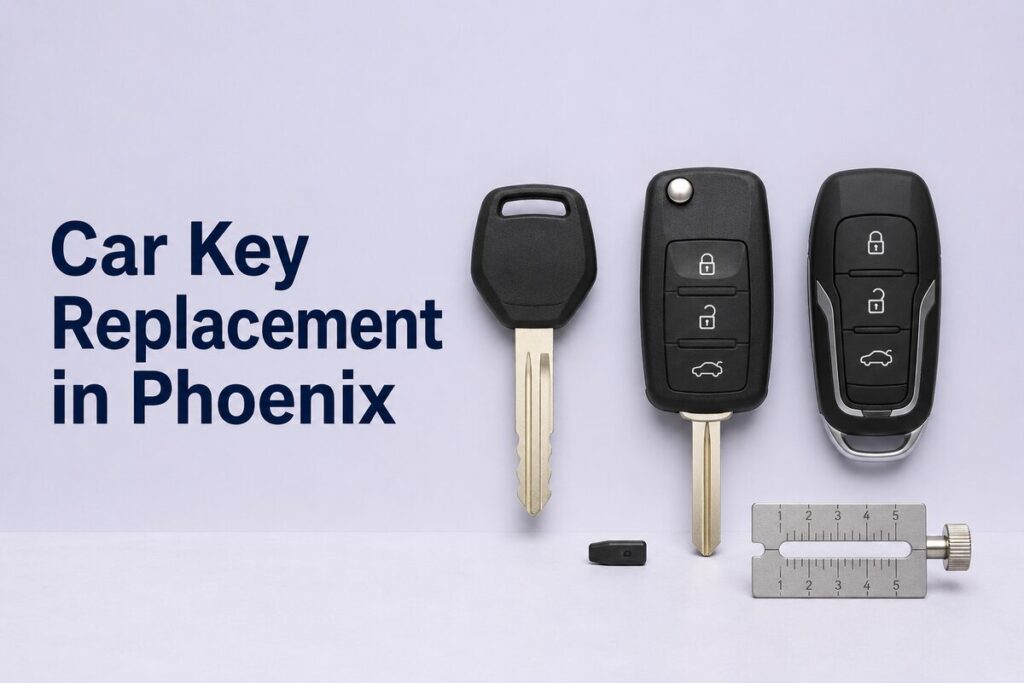
Car key replacement in Phoenix depends on the vehicle’s year, key design, and security system. A traditional metal key may only need to be cut correctly, while a transponder key, remote-head key, or proximity fob may also need electronic programming before it can start the vehicle.
The first step is identifying what was lost or damaged and confirming that the person requesting service is authorized to access the vehicle. That prevents unnecessary parts, programming attempts, and ignition work.
Start by Identifying the Type of Car Key
Car keys that look similar may function differently. The blade can operate a mechanical lock while an electronic chip authorizes the engine to start. Some vehicles combine these functions; others use a proximity fob with an emergency blade.
Traditional Mechanical Key
A mechanical key relies on the cuts along the blade. It may unlock the door and start an older vehicle without electronic authorization. The replacement must still match the correct keyway and cut pattern.
Transponder Key
A transponder key contains a small electronic chip. When the key is used, the vehicle checks for an authorized signal. A blade cut correctly may turn the ignition but fail to start the engine if the chip is absent, incorrect, or not programmed to the vehicle.
Remote-Head Key
A remote-head key combines a blade, transponder chip, and lock or unlock buttons in one housing. Cutting the blade, programming the immobilizer chip, and pairing the remote functions may be separate steps.
Proximity or Smart Key Fob
A proximity fob allows compatible vehicles to recognize the key without inserting a blade into the ignition. The fob may still contain an emergency mechanical key for door access.
Replacement requires the correct device type and an appropriate pairing procedure for the vehicle.
The company’s car key replacement service covers multiple automotive key situations. Describe the key accurately instead of relying only on terms such as “remote” or “smart key.”
Car Key Replacement in Phoenix for Different Situations
The correct process changes depending on what happened to the original key.
| Situation | What must be checked | Possible service |
|---|---|---|
| Every key is lost | Vehicle ownership, key type, code and programming requirements | Origination, cutting and possible programming |
| Key blade is broken | Remaining pieces, blade wear and lock condition | New blade or complete replacement key |
| Remote buttons fail | Battery, housing, circuit and pairing | Battery, housing, repair or replacement fob |
| Key turns but engine will not start | Transponder recognition and vehicle symptoms | Chip diagnosis or programming |
| Key will not turn in the ignition | Key wear, cylinder condition and steering pressure | Key replacement or ignition evaluation |
All Keys Are Lost
When no working key remains, a technician must identify the key system and establish an authorized replacement. This may involve obtaining key information, cutting a blade, programming a transponder, pairing remote functions, and testing operation.
If the vehicle supports it, old missing keys may be removed from the authorized key memory. This is not identical on every make or model, so ask what the specific system allows.
A missing mechanical blade could still operate a door lock unless the mechanical lock is changed or otherwise addressed.
The Key Is Broken or Severely Worn
A cracked housing, bent blade, separated remote, or worn key can create different failures. If part of the blade is stuck in a door lock or ignition, avoid pushing it farther inside. Extraction should protect the surrounding cylinder before a replacement is cut.
Copying a heavily worn key may reproduce its errors. A replacement should be based on reliable key information or a suitable original rather than assuming every existing duplicate is accurate.
A Spare Key Is Needed
Creating a spare while a working key is available may simplify identification and testing. The technician can compare both keys and confirm mechanical and electronic operation.
Keep the spare in a controlled location. Avoid labeling it with the complete vehicle address or leaving it inside the vehicle it is intended to open.
Transponder Programming Is Different From Remote Programming
The immobilizer chip and remote buttons do not always use the same programming process. A transponder authorizes starting, while the remote usually controls functions such as locking, unlocking, or releasing the trunk.
A key can therefore produce mixed symptoms:
- The blade unlocks the door, but the engine does not start.
- The engine starts, but the remote buttons do not respond.
- The remote works, but the emergency blade is cut incorrectly.
- A proximity fob is recognized intermittently because of its battery or another issue.
Professional key fob programming should include identifying the correct device, completing the supported pairing procedure, and testing every relevant function.
Programming cannot correct a physically incompatible blade, damaged ignition cylinder, or unrelated vehicle fault.
Information to Prepare Before Requesting Service
Accurate information helps identify the appropriate key and equipment. Be prepared to provide:
- Vehicle make, model, and year.
- Vehicle location within the Phoenix Metro area.
- The key style, including buttons or proximity features.
- Whether any working key remains.
- Whether the key is lost, broken, locked inside, or electronically unrecognized.
- Vehicle identification information when requested.
- Proof that you own or are authorized to access the vehicle.
The technician should verify authorization before creating or programming a key. Identification and vehicle registration, title documentation, rental paperwork, fleet authorization, or another reasonable form of verification may be required depending on the situation.
If the keys are simply locked inside, car lockout service may be the appropriate first step. Retrieving a working key is different from originating a new one.
When the Key Is Not the Main Problem
Not every starting or turning problem means the key needs replacement. A worn ignition cylinder may bind even when the key is correct. Steering-wheel pressure, a damaged wafer, debris, or another mechanical issue can prevent normal rotation.
Compare symptoms before deciding:
- If every available key has trouble turning, the ignition cylinder may need evaluation.
- If one worn key fails but a cleaner spare works, the key may be the primary issue.
- If the key turns but the security indicator behaves abnormally, electronic recognition may be involved.
- If the engine cranks but does not run, the cause may extend beyond locksmith work.
The company’s ignition repair service can be reviewed when symptoms point to the cylinder rather than only the key. A technician should explain the distinction before recommending ignition work.
How Phoenix Heat and Dust Affect Automotive Keys
Phoenix conditions can affect key housings and electronics. Direct sun or a hot vehicle exposes the battery, shell, buttons, and internal circuit to high temperatures that may contribute to brittle housings or worn button surfaces.
Fine dust can collect around:
- Button edges.
- Blade pivots.
- Emergency-key releases.
- Ignition openings.
- Damaged seams in the key housing.
Water and debris from monsoon conditions can also affect a damaged fob whose housing no longer seals correctly.
Protect the key by keeping it out of prolonged direct sun, replacing a cracked case before internal components are exposed, and avoiding an overloaded key ring that places additional weight on a mechanical ignition.
Battery replacement should follow the fob manufacturer’s procedure and correct battery orientation.
What the Replacement Process Should Include
A professional replacement generally begins with authorization and key-system identification. The technician then determines the appropriate blank, blade style, chip, remote, or proximity device.
The service may include:
- Verifying vehicle and customer information.
- Identifying the correct key or fob configuration.
- Cutting the mechanical blade when applicable.
- Programming the transponder or proximity device when required.
- Pairing supported remote functions.
- Testing door access, ignition authorization, buttons, and emergency blade operation.
- Confirming how remaining or missing keys interact with the vehicle system.
Locksmith Phoenix Mobile Locksmith states that it provides a quote before starting work. Its website describes the business as locally owned and family operated, licensed in Arizona, bonded and insured, with mobile coverage across the Phoenix Metro service area.
The company also states that it has served Phoenix since 2010 and has more than 15 years of experience.
Its About Us page provides additional company information, while the main services page outlines residential, commercial, automotive, and emergency work.
Confirm Every Function Before the Service Is Complete
A replacement key should be tested, not accepted by appearance alone. Confirm that the blade turns authorized locks without excessive force, the vehicle recognizes the transponder, and supported remote or proximity functions operate correctly.
If more than one replacement is created, test each key separately. Keep track of which original or spare keys still work, especially after an all-keys-lost programming procedure.
The following functions may need to be checked depending on the key:
- Mechanical door access.
- Ignition rotation.
- Immobilizer authorization.
- Lock and unlock buttons.
- Trunk-release button.
- Panic button.
- Proximity detection.
- Push-button starting.
- Emergency mechanical blade.
Mobile coverage includes Phoenix neighborhoods such as Downtown Phoenix, North Mountain, and Central Phoenix.
Confirm coverage for the vehicle’s exact location when requesting assistance.
Car Key Replacement in Phoenix: Frequently Asked Questions
What types of car keys can a locksmith replace?
Depending on the vehicle and available equipment, replacement may be possible for traditional mechanical keys, transponder keys, remote-head keys, emergency blades, and proximity key fobs. The vehicle’s make, model, year, and security system determine the required key.
Can a replacement key be made when every original key is lost?
Many vehicles support key origination when no working key remains. The process may include identifying the correct key, cutting the blade, programming the transponder or proximity device, and testing the completed replacement.
What proof is required before making a car key?
The technician should confirm that the customer owns or is authorized to access the vehicle. Identification, registration, title documentation, rental paperwork, fleet authorization, or another reasonable form of verification may be requested.
What is the difference between a transponder key and a key fob?
A transponder chip communicates with the vehicle’s immobilizer to authorize starting. A key fob may control locking, unlocking, trunk release, proximity access, or push-button starting. Some devices combine both functions.
Why does my newly cut key turn but not start the engine?
The mechanical blade may be correct while the transponder chip is missing, incompatible, or not programmed to the vehicle. Mechanical cutting and electronic authorization are separate requirements on many vehicles.
Can a replacement be copied from a worn or broken key?
A heavily worn key may contain inaccurate cuts that should not automatically be duplicated. The technician may need reliable key information or another suitable key to produce a replacement that operates correctly.
Can a lost key be removed from the vehicle’s memory?
Some vehicle systems allow missing electronic keys to be removed from the authorized key memory during programming. Available procedures vary by make, model, year, and security system. Mechanical door access may require separate consideration.
Do I need a new key if the ignition will not turn?
Not necessarily. A worn key may be responsible, but the ignition cylinder, internal wafers, debris, alignment, or steering pressure may also cause the problem. The key and ignition should be evaluated before deciding which component needs service.
Can Phoenix heat damage a car key fob?
Prolonged heat and direct sunlight may affect the plastic housing, battery, buttons, seals, and internal electronics. A cracked or poorly sealed case can also allow dust and moisture to reach the internal components.
What should be tested after receiving a replacement car key?
Test mechanical door access, ignition or start authorization, lock and unlock buttons, trunk release, panic function, proximity detection, and the emergency blade when those features apply. Each replacement key should be tested separately.
Final Thoughts
Car key replacement in Phoenix may require mechanical cutting, transponder programming, remote pairing, or a combination of all three. Identifying the key type and the actual failure prevents a worn blade, dead fob battery, programming issue, and damaged ignition from being treated as the same problem.
For lost, broken, or electronically unrecognized keys, call Locksmith Phoenix Mobile Locksmith at (602) 834-2303 or use the contact page.
Non-urgent questions may also be sent to info@locksmith-phoenix-mobile-locksmith.com.
